
Amara's Law
Amara's Law states that we tend to overestimate the effect of a technology in the short run and underestimate it in the long run.
It is named after Roy Amara, a researcher and past president of the Institute for the Future. It is a rule of thumb rather than a scientific law, but it describes the pattern behind most technology booms, busts and quiet revolutions.
The Pattern
Expectations rise faster than real capability. When reality catches up slowly, disappointment follows, and people write the technology off. Meanwhile, the boring work of making it reliable, cheap and well understood keeps compounding until it reshapes entire industries.
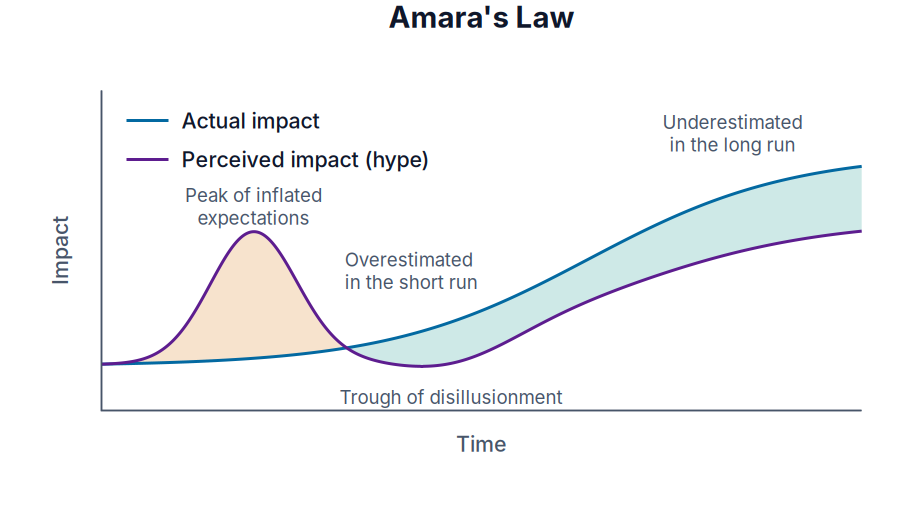
Illustrative only: the purple line is perceived impact (hype), the blue line is actual impact. The gap is positive early (overestimation) and negative later (underestimation).
Examples you have probably lived through:
- The web and e-commerce: the dot-com crash punished the overblown expectations of 1999, yet online commerce went on to reshape retail far beyond those early forecasts.
- Cloud: early "move everything" promises fell flat, but a decade later it is the default substrate for most software.
- Machine learning and generative AI: each wave brings promises of instant transformation, followed by a sobering look at integration, cost and reliability. The long-term effect is likely bigger than most current predictions, and slower than most current demos suggest.
Why CTOs Should Care
Amara's Law is a useful brake and a useful accelerator, depending on where you are in the cycle.
- Resist the short-term pitch: When the board, a vendor or your own team says "this changes everything this quarter", assume the timeline is optimistic. Budget for integration, training, security and process change.
- Don't dismiss it after the trough: When the hype fades and the sceptics declare it dead, that is often when capabilities are quietly maturing. Keep a small team learning.
- Avoid whiplash: Reorganising, hiring or rewriting around a trend at its peak is expensive. Cancelling all exploration at its trough is equally costly.
- Plan in horizons: Treat short-term bets as experiments with a clear learning goal, and long-term bets as capability building with patient funding.
Putting It to Work
- Separate the signal from the noise: Ask what has actually changed: cost per unit, reliability, latency, or a new class of problems that is now solvable. Demos and press releases are not evidence.
- Run small, time-boxed experiments: Define success criteria upfront, such as a measurable cost or cycle-time improvement, so you can judge the result without being swayed by sentiment.
- Track technologies explicitly: Use a Technology Radar to record where each technology sits (assess, trial, adopt, hold) and revisit it on a regular cadence.
- Fund learning continuously: Keep a modest, steady investment in emerging technologies rather than boom-and-bust spending. It keeps your team ready when the long-term effect arrives.
- Mind the organisation: Even when the technology is ready, your organisation may not be. See Martec's Law for why adoption lags capability.
- Use a structured intake: The New Technology Introduction process gives you stage gates so enthusiasm does not skip the due diligence.
Common Traps
- Treating a lull as a verdict: Reduced press coverage is not the same as reduced value.
- Confusing a demo with a product: Prototypes hide the hard 80%: edge cases, scale, compliance and operations.
- Anchoring on today's limits: Capabilities and costs improve steadily. Ask what would be true if this were ten times cheaper and twice as reliable.
- Ignoring second-order effects: The biggest long-term changes often come from new business models and behaviours, not the technology itself.
Explore Next
- Technology Adoption Lifecycle — How different groups adopt a technology over time.
- Martec's Law — Why organisations absorb technology change more slowly than it arrives.
- Technology Radar — A practical way to track what to assess, trial, adopt or hold.
- New Technology Introduction (NTI) Process — A staged process to bring new technology in with controlled risk.
References
- Roy AmaraWikipedia — Background on the researcher behind the law.
- Gartner hype cycleWikipedia — A well-known (and debated) model of the expectations curve.
- Institute for the Future — The research institute Roy Amara led as president.